![Yacht Rock Revue[1]](https://b4113423.assetcdn.net/2.0/4113423/wp-content/uploads/2026/10/Yacht-Rock-Revue1-218x150.jpg?lossy=2&strip=1&webp=1 "The Art of Healing")













By Helen Petre
Insects do amazing things. Autumn is a time of activity: migrating, mating, laying eggs, and insects do that really well. There are many different strategies for passing on DNA, but insects can do things even humans cannot. If you look around at insects in the fall, many are trying to pass on their DNA, and the males are persistent about ensuring the female uses his DNA for the next generation, so he usually hangs around until she actually lays eggs, which can sometimes be a really long time.
Love bugs
Love bugs, Plecia nearctica, are named for the way they fly around attached to each other. That is a pretty common mating strategy and for good reason. Females can mate many times and males are smart enough to stay around to make sure the female uses his sperm. If the female decides there is a genetically better male, she can ditch the male and copulate with the new one. Love bugs take this attachment strategy to extremes, staying together, even in flight, for several days. In fact, they stay attached for their entire adult lifetimes. All the adults ever do is mate, fly around attached, lay eggs, and die. What a life.
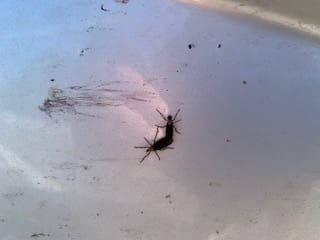
Mating season lasts about a month. Each specific insect only lives three or four days, and all they do is mate the entire time. Adult lovebugs sip nectar, just like butterflies, but they sip while copulating.
Love bugs do not bite or sting, and are not a health hazard to humans. The larvae live in lawns, eat dead stuff, and are virtually never seen. Each female lays 350 eggs, right there on your lawns, even though you never see the eggs or hatchlings. Eggs hatch in three days, but the larvae stay in the lawn, eating dead stuff, for probably a year, until they do the flying around attached thing, the next year. Most adult insects, including butterflies, only live for a few days or weeks. Some do not eat or drink. They just mate, lay eggs, and die.
Cicadas
Another common insect that makes a lot of noise in the fall is the cicada. The one in the picture has just emerged from the exoskeleton and is drying out before flight. Cicadas have been pretty loud this season, and are easily found because they shed their exoskeletons on tree trunks. Only the male sings. Our cicadas are about two and a half inches long. Adults are around singing and looking for mates for about two months, but each individual only lives a few weeks. Like love bugs, cicadas spend most of their lives underground feeding on roots. Unlike love bugs that have annual cycles, cicadas spend up to ten years underground before coming out to mate. Even though it takes ten years, each year some individuals have completed the ten years, and emerge as adults, so they are not periodic cicadas, like the northern ones that come out every 17 years in droves. Ours are with us every year.

Actually, they molt four times underground, and the fifth time come to the surface and become mate seeking adults. The males make all that noise trying to attract females. That is how the females find the right species of male. After they mate, the female lays eggs on trees. The eggs hatch in a few weeks and the nymphs fall to the ground and stay there for years eating roots. .
Like love bugs, cicadas are harmless to humans. They do not bite, sting, or carry disease. The song is loud, though, even louder than a contemporary church service, or loud lawn equipment, at about 90 decibels. In fact they sort of sound like lawn equipment. Cicadas are food for birds, reptiles, fish, and squirrels. There are even wasps, called cicada killers, which sting the cicadas and eat them. I have not seen them here, but in Louisiana, they were everywhere, and very successful at catching cicadas.
The loud cicadas we have on the Panhandle are probably dusk singing cicadas (Tibicen auletes). They are really big, sing at dusk, and are very loud.
Stick insects
Look closely and you will see there are two stick insects. These two, a male and a female, are mating on a ragweed plant in a beautiful field near my house. (Yes, old vacant fields are beautiful, and perfect habitat for butterflies and other pretty native organisms.) Anisomorpha buprestoides, the southern two striped walking stick, is large (about three inches and fat) and has stripes. The male is skinny (and about two inches). In fall, they can be found in old fields and forest edges, the male riding on the fat female. Walking sticks are herbivores, and they have a defensive spray which they deploy quite accurately up to a foot away, but these were busy while I was taking pictures, and did not feel threatened.

These are just a few of the insects that are seen and heard in fall. They live close enough to our housing communities that if we look, or listen, we can learn about organisms that are part of our ecosystems. Unfortunately, people seem to be terrified of bugs, and try to kill them, but these insects are not hurting us, and the world would be a lonely place without them. Go out and enjoy the living things that thrive in our communities, and hopefully cohabitate with us.
Helen Petre is a retired biologist, always excited about the organisms that share our world. If you have questions or suggestions: petrehelen@gmail.com.