









By Helen Petre
I volunteer at the E.O.Wilson Biophilia Center, helping Turtle Bob teach fourth and seventh-graders about snakes and turtles. When the students enter the Turtle Bob room, some are terrified. By the time the class is over, Turtle Bob has convinced even the most uneducated that snakes are our friends. All the snakes the students hold are non-venomous and accustomed to being held. We teach the students that they will encounter snakes in the wild if they go outside.

Most of our snakes in the Panhandle are non-venomous, but a few, like our common cottonmouth, are venomous. Even so, if you wear shoes and keep your hands where you can see them, you will be fine. Venomous snakes do not chase you down or attack you unless you try to kill them, step on them in bare feet, or pick them up. Like bears and bobcats, give them room, do not threaten them, and you will be fine. Any snake will bite if threatened. Any human probably will, too.
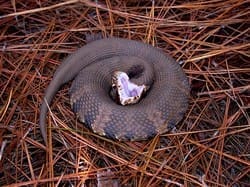
Eastern cottonmouth (Agkistrodon piscivorus piscivorus)
The cottonmouth is our most common venomous snake. It swims well, lives near water, and opens its mouth when threatened. Cottonmouths sometimes shake their tails when threatened, sort of like rattlesnakes. They are just trying to let you know they are there, and they hope you will go away. When cottonmouths are swimming, you can see their entire body on the surface of the water, unlike other water snakes.
Cottonmouths have big heads and skinny necks. They are very thick snakes with very thick tails. They look scary, but, unless you step on them in bare feet or try to kill them, they will not bite. Venomous snakes use venom to subdue prey. You are not prey. You are way too big to swallow. Bites are last resorts to make you go away.
Contrary to public opinion, cottonmouths are not aggressive. I almost stepped on one wearing flip flops (which is not a good idea), and the snake just sat there with its mouth open. Yes, I was terrified, but it did not bite. Bites are very uncommon, and although they are not fun, they are very rarely fatal.
Cottonmouths are food for eagles, owls, herons, alligators, kingsnakes, and snapping turtles. They eat fish and frogs. They are important members of an ecosystem that we want to preserve.
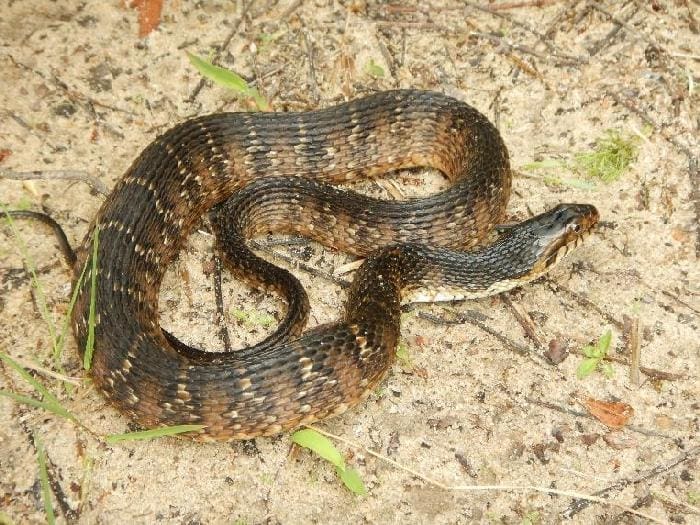
Banded watersnake (Nerodia fasciata)
Some snakes look like venomous snakes, and they do that on purpose. The banded watersnake is a common snake that lives near water like the cottonmouth, but it is not venomous. The banded water snake hopes you will think it is a cottonmouth and leave it alone. Sometimes that works. The difference is that banded watersnakes have long, pointed heads (not triangular), round eyes, they do not open their mouths when threatened, and you cannot see their entire body when they swim, only their heads. They, and especially their tails, are much thinner than those of a cottonmouth. They also have dark, vertical lines on their heads that are visible in the photo below and can be seen from a safe distance.
When a banded watersnake is threatened, it flattens out its head, but don’t be fooled. The head looks flat, not blocky like a cottonmouth.
Red rat snake (corn snake, oak snake) (Pantherophis guttatus)
Red and gray rat snakes are also called oak snakes and corn snakes. They look alike except some are red and some are gray, or brownish. Red corn snakes are expert climbers. Some people think they look like copperheads, but copperheads are rare in the Panhandle.
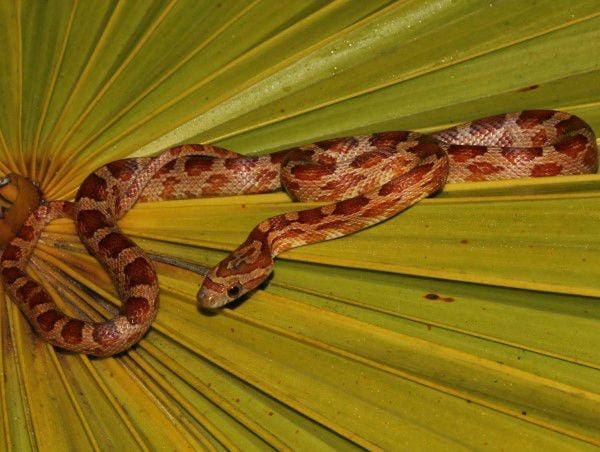
Red and gray rat snakes are constrictors, but have no fear, they are way too small to strangle you. They constrict around a mouse, or other rodent when it exhales, and then it cannot inhale. It sounds terrible, but death is quick. Rat snakes are useful to control rodent populations and are beneficial to humans because rodents carry ticks and disease and spoil human food. Rat snakes live about 15 years in the wild in palmetto flatwoods and forests.
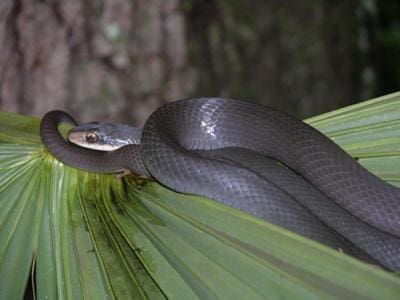
Black racers (Coluber constrictor)
Black racers, or black snakes, are probably the most common urban snake. They are active during the day, so they are often seen. Black snakes live around freshwater and under shrubs. They eat insects, frogs, and toads. They are also slightly hyperactive and large, so they tend to move quickly and scare people. They do not do well in captivity because they cannot tolerate life in a small box.
What to do if you see a snake
Nothing. Move away. Give the animal room and take a deep breath. The snake does not want to chase you, bite you, or eat you. It wants you to go away. So go away.
There is no good reason to kill a snake, and if you try, it might not end well for you. If you have snakes in your yard, it is probably because there is food: rodents, bird seed, or pet food. Remove the rodent food and the rodents and the snakes will leave.
Snakes are assets to our environments. They eat mice, rats, and other things that we do not want around our yards. Snakes are food for owls, herons, snapping turtles, and alligators. Like all wild animals, they were here first, and despite the Adam and Eve story, they do not tell us to do bad things. They just want to be left alone to enjoy the sun and rodents. We love snakes at the Turtle Bob room, and we hope you love them in your yards and in the wild.
Helen Petre is a retired USDA biologist and college biology instructor. Turtle Bob is the turtle guy at E. O. Wilson. We both hope to share our passion for the longleaf ecosystem with all the wonderful people who live here. If you have any questions about science, nature, or the wild world of Florida’s Panhandle, email petrehelen@gmail.com