












By CLINT GHARIB, AIF®, CFEd®
The Sale We Have Been Preparing For
This past week I received calls from three clients—not panicking, but close—because of the sharp decline in technology stocks.
I understood their concern. Watching investments fall is never comfortable. What surprised me was how quickly they seemed to forget what I had been writing and discussing for months: a real technology correction was coming, it could be swift and steep, and we needed to prepare before it arrived.
To me, this July plunge is that selloff.
I do not know the exact bottom, and stocks may decline further before this runs its course. But a sharp correction does not end the long-term opportunity.
During my 37 years managing stocks, I have seen this pattern repeatedly. A powerful advance is interrupted by a sudden decline, fear makes the drop feel permanent, and the recovery begins before investors feel comfortable believing it.
Most recently, technology stocks fell sharply over roughly seven weeks between February and April 2025. Many of the hardest-hit technology leaders then rebounded quickly. History does not provide an exact timetable, but it does provide perspective: markets can fall much faster than seems reasonable and recover before the headlines become reassuring again.
This is why I have advocated trimming gains, pruning weaker investments and allowing cash to accumulate. Cash may feel frustrating while stocks are rising, but it gives investors choices when others are frightened into selling.
The latest source of fear is Kimi K3, a new Chinese artificial-intelligence model that has revived memories of the DeepSeek panic in early 2025. Investors quickly moved from “a formidable competitor has arrived” to “the entire AI investment cycle may be over.”
Those are not the same conclusions.
Better and less expensive AI models may actually accelerate adoption by making artificial intelligence available to more businesses and people. That will create different winners and losers, but it does not eliminate the need for computing, memory, networking, electricity, cooling, cybersecurity and data infrastructure.
Artificial intelligence is also moving into a new phase. Phase One focused largely on building and training models such as ChatGPT. Phase Two is about putting that intelligence to work through reasoning, inference and AI agents.

Instead of simply answering a question, an AI system may review multiple sources, operate software, solve a complicated problem and complete an entire project. That requires far more computing than producing a simple chatbot response.
One model may advertise a lower price per AI “token” but require many more tokens to produce the correct result. It is like a car using cheaper fuel but burning twice as much to travel the same distance. What matters is not simply the price of each token, but the total cost of completing useful work.
As intelligence becomes less expensive, businesses will likely discover many more ways to use it. Lower costs could therefore increase infrastructure demand rather than reduce it.
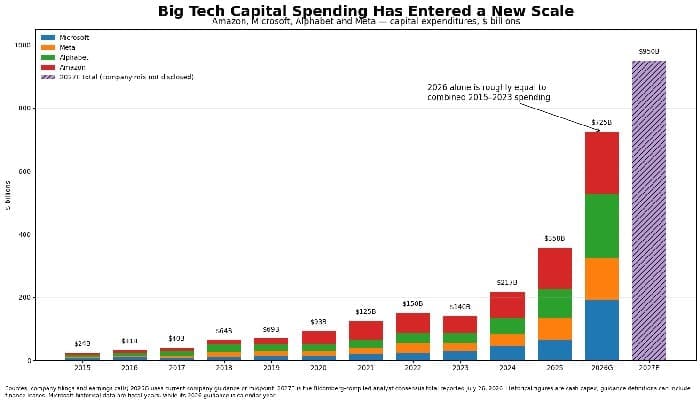
The spending plans support that view. Amazon, Microsoft, Alphabet and Meta spent approximately $217 billion on capital expenditures in 2024 and roughly $358 billion in 2025. Their current plans call for about $725 billion in 2026 alone—roughly equal to everything those companies spent during the entire nine years from 2015 through 2023. Current analyst estimates place their combined 2027 spending near $950 billion.
Capital expenditures are companywide and are not exclusively AI spending. Historical figures are based on reported cash capital expenditures; current guidance and analyst estimates may use somewhat different definitions. Sources: Company filings and current guidance as of July 26, 2026; 2027 represents analyst estimates.
Not every dollar will produce an adequate return, and not every company will benefit equally. That is why stock selection matters.
The trees are today’s falling prices, frightening headlines and worries about Chinese competition. The forest is the much larger transformation taking place.
Some trees may become damaged. Some may even fall.
That does not mean the forest has disappeared.
This is the moment to remember the forest—and why we prepared before the trees began shaking.
We’re here to help answer your financial life and investing questions.
Image created using AI-assisted digital artwork directed by Clint Gharib. Opinions expressed are that of the author and are not endorsed by the named broker/dealer or its affiliates. All information herein has been prepared solely for informational purposes and should not be considered legal or tax advice. It is not an offer to buy, sell, or a solicitation of an offer to buy or sell any security or instrument to participate in any particular trading strategy and is not intended to provide, & should not be relied on for, tax, legal or accounting advice. You should consult your own tax professional regarding your specific situation. Past performance does not guarantee future results. Certain statements contained within are forward-looking statements including, but not limited to, statements that are predictions of future events, trends, plans or objectives. Undue reliance should not be placed on such statements because, by their nature, they are subject to known and unknown risks and uncertainties. Oxford Retirement Advisors is an independent firm with Securities and Advisory services offered through Madison Avenue Securities, LLC (“MAS”), member FINRA/SIPC and a Registered Investment Advisor. Oxford Retirement Advisors and MAS are not affiliated entities