![Yacht Rock Revue[1]](https://b4113423.assetcdn.net/2.0/4113423/wp-content/uploads/2026/10/Yacht-Rock-Revue1-218x150.jpg?lossy=2&strip=1&webp=1 "The Art of Healing")












By Helen Petre
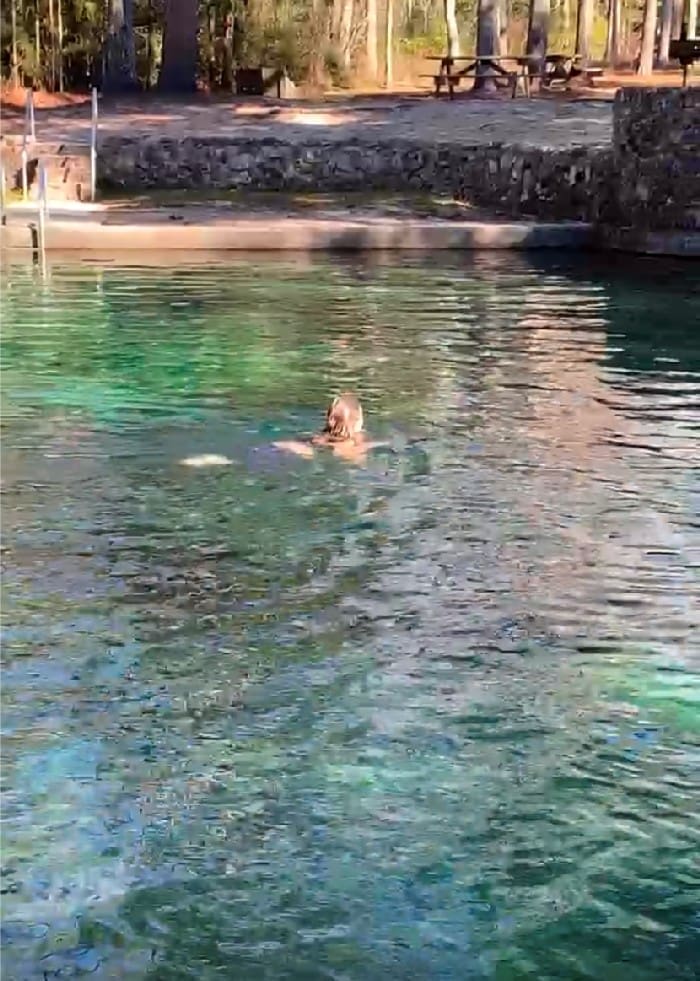
No, probably not, but the springs named after him are well worth protecting. I usually write about wild places and organisms in Freeport and South Walton, some even in south Bay County, but now that it is winter, the 68-degree Fahrenheit water in the north Walton springs calls to me. Well, sort of. It is still cold, but kind of exciting to get in, just to say I did.
The source
Florida has more springs than any other state, and perhaps any place on Earth, with over 1,000 in the state. The springs are our water source. In fact, 92% of our drinking water comes from the Floridan Aquifer, and the water that comes out of the springs is this water. Springs flow because the pressure in the aquifer is high. As we continue to develop land and use water, that pressure goes down and the amount of water released by the springs decreases. Both Morrison and Ponce de Leon springs are second-magnitude springs based on outflow.
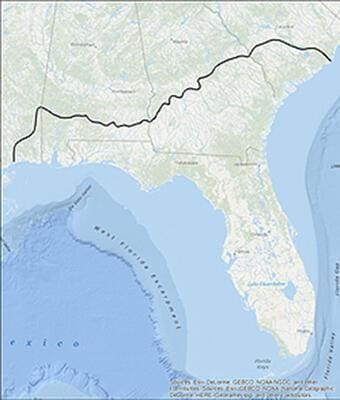
The water in the Floridan Aquifer is a constant 68 degrees Fahrenheit. The aquifer is composed of porous limestone and dolomite that is hundreds of feet thick and was formed 35 million years ago. The Florida Aquifer is fed by rainwater that seeps into the ground north of Florida and flows south by gravity through the porous limestone. The water in this aquifer is our groundwater, and as such, is susceptible to contamination.
Many places are named for the Spanish explorer, Ponce de Leon, but he probably never went to most of them. He explored Florida in 1513, notably before air conditioning or mosquito control. If he was trying to find the famed Fountain of Youth, he failed miserably, but in reality, he never even thought of that. Still, we have some great springs, regardless of the myths.
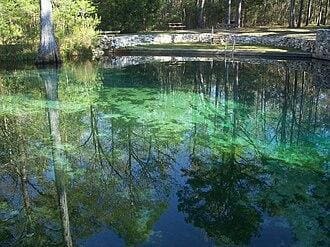
Ponce de Leon Springs produces 14 million gallons of water a day. The spring head is 20 feet deep and a clear stream flows from it to the tannin-stained Sandy Creek, which flows into the Choctawhatchee. Ponce de Leon and Morrison Springs are two of the 13 springs that drain into the Choctawhatchee River.
What about the Native Americans?
If Ponce de Leon did find the spring, he also found the Native Americans who lived there. There is little evidence of the history, but we think the Chatots inhabited the land between the Chattahoochee and the Choctawhatchee, including the springs, which is a really big area. The Chatots were fiercely protective of their land, so if Ponce de Leon met them, he probably had a hard time.
In 1840, Spanish settlers built a log hotel and enjoyed the clear water, fishing, and swimming, just as we do today. In 1864, Union soldiers destroyed the hotel. The Smithgall family owned the land in the 1920s, but no trace remains.
Plants and animals
Although everyone comes for the spring, there are notable plants at Ponce de Leon Springs, including pitcher plants, flame azaleas, and mountain laurel. There are longleaf pines that were used in the turpentine industry in the higher, drier areas, and some trees still show the “catface scars” made to extract the resin. Among the pines are rhododendron, hickory, huckleberry, milkweed, blazing stars, oaks, magnolia, saw palmetto, and blueberry.
The habitat is suitable for alligators, turtles, gopher tortoise, turkey, fox, deer, and bobcat. Catfish, bass, bluegill, sunfish, warmouth, crappie, and pickerel are common in the springs and in Sandy Creek. Northern wrens, kinglets and brown creepers spend the winter here.
There are two short nature trails. The sign says it takes 45 minutes, but it really takes ten.
Morrison Springs
Producing 48 million gallons a day, Morrison Springs is south of Ponce de Leon State Park. There are three cavities into the Floridan Aquifer here, the deepest of which is 300 feet deep. Cyprus knees stand out of the water, but there are no nature trails.
Because of the limestone rock of the aquifer, there are many caves. Caves are dangerous for inexperienced underwater explorers.
Springs of Walton County
The springs are unique ecosystems with unique histories that are more than fun places to go on hot summer days or even cold winter days. They represent a window into our water supply and a chance to understand how water moves through the aquifer to supply our needs and the needs of the plants and animals that depend on the water. The springs are one more reason to be grateful for our resources. Enjoy the plants and animals and jump in. Getting out is the hard part!
Helen Petre is a retired USDA biologist and college biology professor. She spends her time volunteering, teaching, and writing science articles to share her interests with future generations.